Research
I use networks of low-cost cameras, and the software that turns their video into physical measurements, to study three things in and above Earth's atmosphere: meteors, the dust and rocks from space that burn up as shooting stars; satellites and space debris in low Earth orbit; and the contrails that aircraft leave behind, which warm the climate. My core expertise is the origin and evolution of the small bodies of the Solar System: meteoroids, asteroids and comets. Below, "I" refers to my own work and "we" to my group and our collaborators.
The program has three long-term aims:
- an observation-based picture of the orbits and physical structure of meteoroids that helps explain how the Solar System formed;
- tracking of satellites and debris in low Earth orbit, including how bright they appear in the night sky;
- an operational system that helps aircraft avoid making warming contrails.
On this page: The Global Meteor Network · Meteor physics and planetary defence · Space situational awareness · Climate change mitigation · Current projects · How we work · Running the program · Invited talks · Looking ahead · Supporting this work · References
The Global Meteor Network
I started the Global Meteor Network (GMN) in 2018 (how it came to be) with a simple idea: a Raspberry Pi and an inexpensive security camera, running the right software, can do science that used to require purpose-built systems costing tens of thousands of dollars. A complete GMN station now costs a few hundred dollars and can be built by anyone.
Today more than 1,600 cameras in 45 countries are run by more than 900 volunteers, schools, clubs, observatories and universities. The GMN is powered by citizen scientists and is one of the most successful citizen science projects in the world. Our software on each camera detects meteors and calibrates the data. Our central server at Western then combines the views of several cameras to compute each meteor's trajectory and orbit with realistic uncertainties (Vida et al. 2021; Vida et al. 2020): more than 2.8 million orbits by the end of 2025. Together the cameras process about a petabyte of video every day, and in 2025 alone the network computed about 966,000 orbits. The cameras see the sky much as a person does, with similar sensitivity and field of view, so the same data also serve for fireballs, satellites and contrails. Our software for measuring meteor rates (Vida et al. 2022) lets NASA warn spacecraft operators about meteor shower activity on the same day.
Live GMN data on this site · GMN website · Open data · How to build a station and join
1. Meteor physics and planetary defence
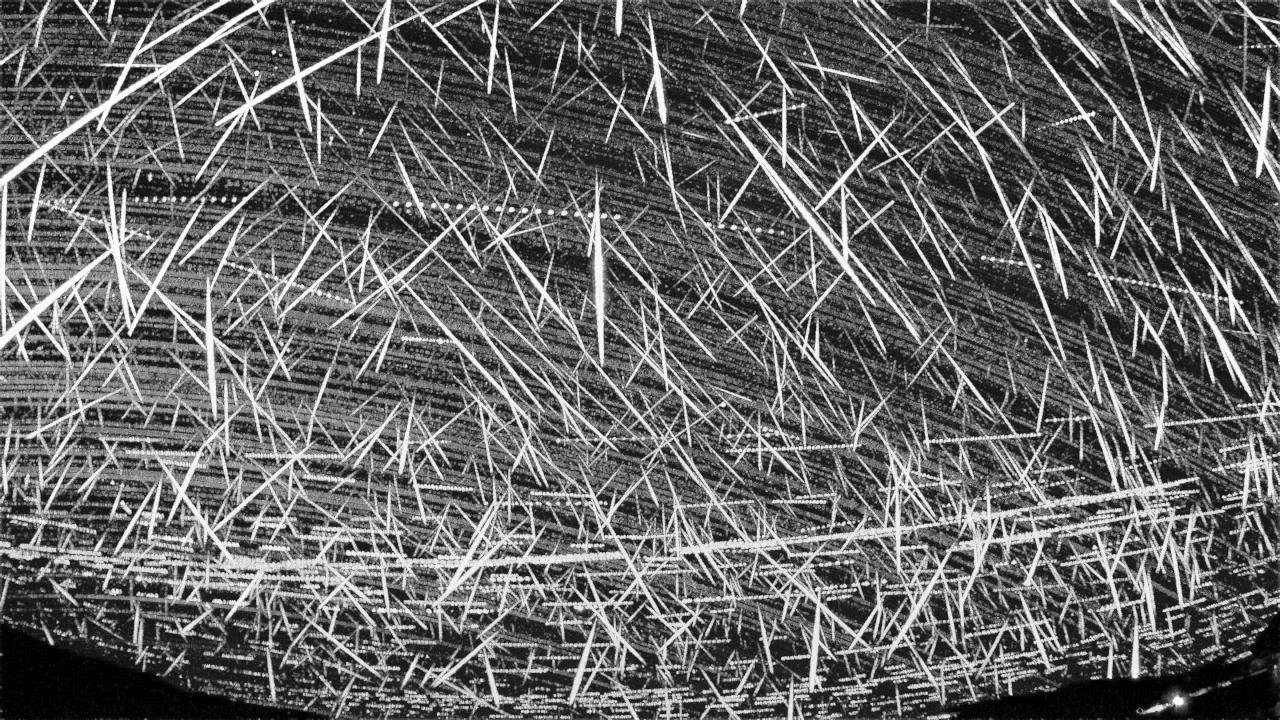
Meteoroids and other small bodies carry clues to how our planetary system formed and evolved. Earth sweeps up tens of thousands of tonnes of this material every year, and each meteor is an object from somewhere in the Solar System entering the atmosphere at up to 70 km/s. We use the interaction of particles from micrometres to metres in size with the atmosphere to infer where they came from and what they are made of.
Physical properties from numerical models
A meteor's brightness and deceleration depend on how the meteoroid heats up, loses mass (ablation) and breaks apart. We fit physical models of this process to high-precision observations, such as those of the Canadian Automated Meteor Observatory, and use Bayesian statistics and machine learning to measure the density, strength and structure of millimetre-sized meteoroids (Vida et al. 2024a; Vovk et al. 2025; Vovk et al. 2026). The same approach gave the first direct measurement of a decimetre-sized rock arriving from the Oort cloud, the distant reservoir of icy bodies at the edge of the Solar System. It showed that the Oort cloud holds rock as well as ice, and the paper was a cover article in Nature Astronomy (Vida et al. 2023).
How much material reaches Earth
We measure how many meteoroids of each size reach Earth (the flux):
- millimetre-sized sporadic meteoroids, those not part of any shower, which pose the highest impact risk to satellites in low Earth orbit;
- meteor showers (Vida et al. 2022; Moorhead et al. 2024);
- decimetre-sized fireballs, which show how material from space is delivered to Earth;
- interstellar meteoroids from outside the Solar System, for which we set an upper limit (Wiegert et al. 2025a).
The structure of metre-sized asteroids and planetary defence
When a small asteroid breaks up in the atmosphere, how it fragments reveals its internal structure, which matters for planetary defence. We have studied several asteroids that were discovered in space shortly before they hit Earth (Clark et al. 2023; Kareta et al. 2024; Egal et al. 2025). We also reconstruct fireball trajectories from many kinds of sensors (Scamfer et al. 2026) and compute fall areas that guide meteorite recoveries such as Winchcombe (King et al. 2022).
Meteor showers, their parents and dark comets
Meteor showers also pose a hazard to spacecraft, and several unpredicted shower outbursts in the last decade could have endangered astronauts and satellites. We characterize, model and predict shower activity, from newly discovered showers (Vida et al. 2024b) to outbursts from fragmenting comets (Egal et al. 2023) and the Taurid resonant swarm (Wiegert et al. 2025b; Li et al. 2025). Next, we want to understand “dark comets”, objects that have lost most of their ice, as sources of meteoroid streams and link them to specific parent bodies.
2. Space situational awareness
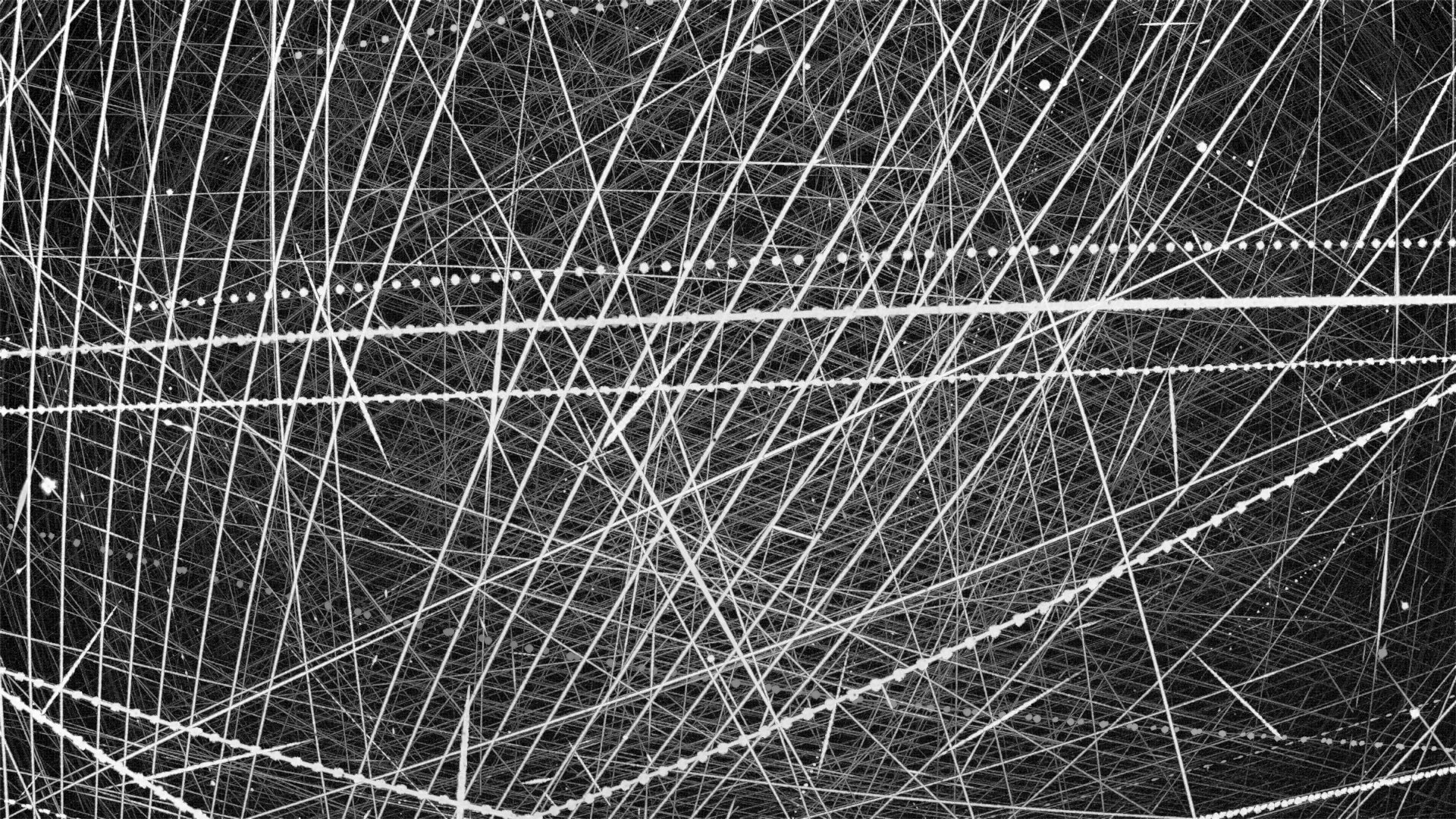
Space situational awareness means knowing where satellites and debris are, where they are going, and how bright they look from the ground. Megaconstellations, fleets of hundreds to thousands of satellites, are being launched faster than regulation can keep up, and their orbits and brightness are often poorly known. Their numbers are set to grow to tens of thousands, threatening both the safety of space assets and the usefulness of the night sky for astronomy.
- Project Luciole. I am co-PI and technical lead of Project Luciole. Building on the GMN cameras, we designed an optical satellite tracking system: arrays of wide-field cameras that image the sky at a high frame rate and track satellites and debris down to decimetre sizes without needing to know in advance where to look (Vida et al. 2024c). It now runs at four sites across Canada and is developed in close collaboration with, and funded by, Defence Research and Development Canada (DRDC).
- Satellites and astronomy. We carried out a large-scale optical survey of how bright megaconstellation satellites appear and how that affects astronomical observations (Johnson et al., in review), and work on ways to reduce their impact on astronomy.
- Re-entries. The GMN's global coverage lets us observe satellite and rocket body re-entries and characterize how they break up. Tam Do presented the first large-scale, systematic optical survey of re-entries with the GMN at the 2026 AMOS Conference in Maui (Do et al. 2026); the full paper will appear in the conference proceedings.
My goal is a nationwide optical network that observes every active satellite in low Earth orbit and provides accurate positions and brightness at high cadence, cheap enough to deploy widely and open to operators, astronomers and regulators.
3. Climate change mitigation
Contrails are the thin ice clouds that form behind aircraft and can spread into sheets of cirrus. They are estimated to cause around 2% of all human-caused warming, more than the warming from aviation's own CO2 emissions, although the uncertainty is large (Lee et al. 2021) and recent estimates differ, which is one reason direct observations are needed. Persistent contrails form only where the air is very cold (below about −40 °C) and so humid that ice crystals keep growing, that is, supersaturated with respect to ice (Schumann 1996). Because a small fraction of flights produce most of the warming, small changes in flight altitude could avoid much of the effect quickly and at low cost (Teoh et al. 2020). Real-world trials have shown that such avoidance is possible (Sausen et al. 2024). This is the main motivation for our work.
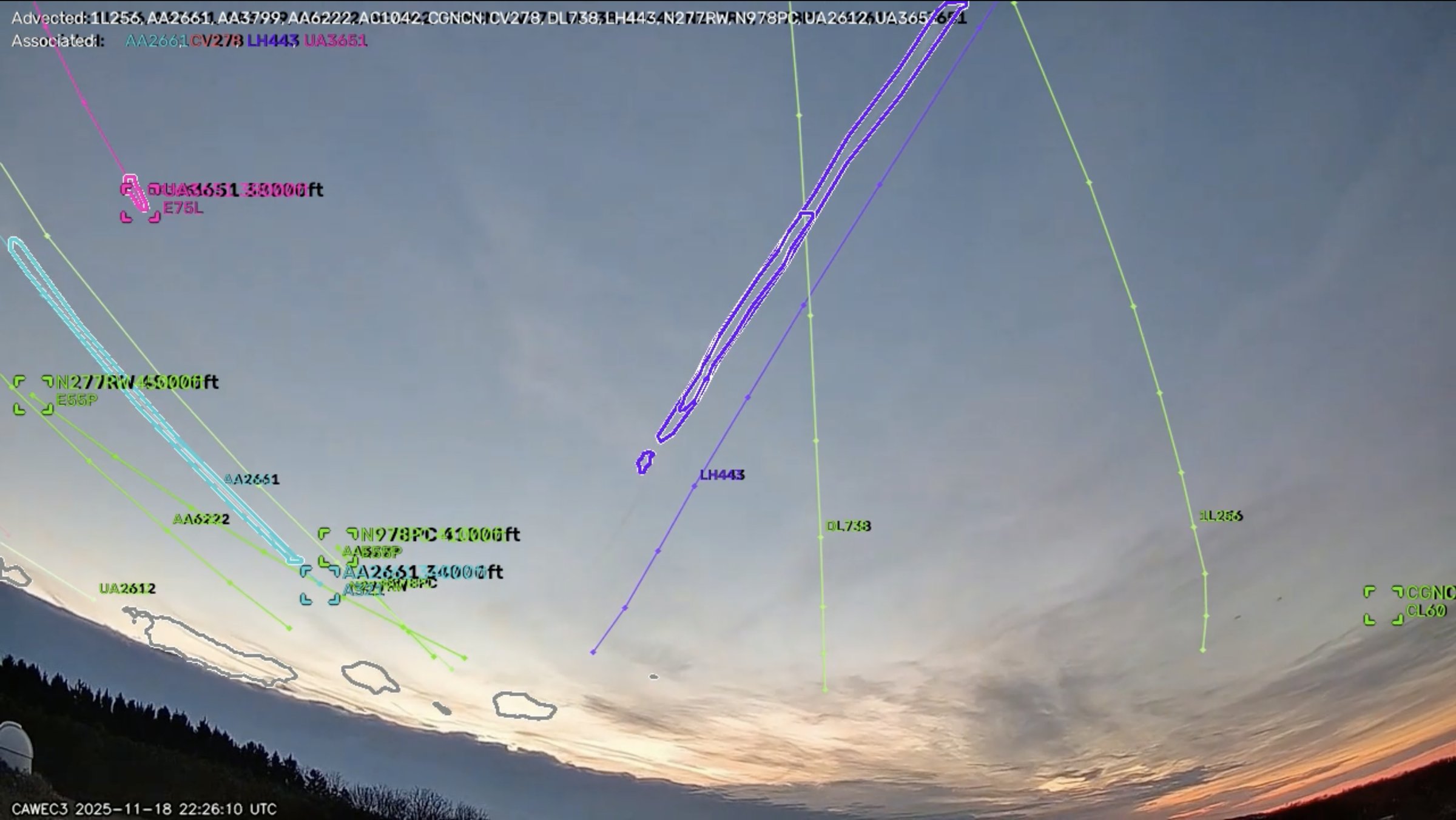
I lead the Western Contrail Research Project, run in close collaboration with Luc Busquin (ContrailCast) since May 2023: I coordinate the team, raise the funding and work with the airlines, industry partners, agencies and research consortia involved. The project turns GMN sky cameras into a contrail observatory that works day and night. Machine learning finds contrails in the images (over 90% accuracy), and we match each one to the flight that produced it (over 95% accuracy, checked on more than 1,350 flights in Arizona, Ontario and Europe). Each matched contrail tells us whether the air at cruise altitude was cold and humid enough for contrails to persist. The pipeline now runs operationally and produces tens of thousands of contrail observations every month.
Weather models cannot yet predict where persistent contrails will form well enough for routine avoidance, mainly because there are few observations to check them against. We are testing contrail forecasts against our camera observations; this work is ongoing, and a publication on it will be out soon. We are writing up the results and working with our external partners so that the system has a real impact on how aircraft fly. Our next goals are to:
- Enable contrail avoidance. Build the world's most comprehensive data set of contrail observations to test atmospheric models, so that airlines can avoid warming contrails as a routine part of operations.
- Measure the warming effect. Quantify the net warming effect of contrails (their radiative forcing) through direct observation, to inform international aviation regulation.
The project is supported by Google Research, Breakthrough Energy, 4AIR and the Western Institute for Earth and Space Exploration, and is part of the Horizon Europe E-CONTRAIL 2 consortium. Our research partners include the National Research Council Canada (NRC), TU Delft, MIT and Imperial College London. E-CONTRAIL 2 is supported by the SESAR 3 Joint Undertaking and its members under grant agreement No 101287164.
Meteors and the cooling upper atmosphere
The mesosphere and lower thermosphere, roughly 50 to 120 km above the ground where meteors burn up, have cooled and contracted over the last two decades (Mlynczak et al. 2022). How much of this is due to CO2 and how much to natural variability and the solar cycle is still debated. Unlike meteor radars, which rely on ionization, GMN cameras see the meteor light directly, so the heights at which meteors begin and end give a new measure of the density of the upper atmosphere. Together with satellite drag, this offers a new way to track climate-driven cooling of the mesosphere. Climate change also affects how meteorite-dropping fireballs reach the ground (Peña-Asensio et al. 2025).
Current projects
| Project | My role | Supported by | Since |
|---|---|---|---|
| Global Meteor Network | Founder, PI | NASA Meteoroid Environment Office; volunteers in 45 countries; private donors | 2018 |
| Western Contrail Research Project | PI and project lead | In close collaboration with Luc Busquin (ContrailCast); supported by Google Research, Breakthrough Energy, 4AIR and the Western Institute for Earth and Space Exploration | 2023 |
| E-CONTRAIL 2 | Consortium member | Horizon Europe | 2026 |
| Project Luciole: optical space surveillance | Co-PI (with P. Brown) and technical lead | In close collaboration with and funded by Defence Research and Development Canada | 2024 |
| Meteoroid physical properties | Research scientist | With the Western Meteor Physics Group | 2020 |
| Climate change and meteorite falls | Co-PI (with E. Peña-Asensio, E. Sansom) | Generalitat Valenciana | 2026 |
| GMN Outreach: cameras and curriculum for schools | PI | Private donors | 2023 |
How we work
My main interest is in fundamental scientific questions about the Solar System and Earth's atmosphere, and in operational questions where better observations lead to better decisions: the risk a meteor shower poses to spacecraft, the true position of a satellite, or which flights should change altitude to avoid a warming contrail. Strong technical skills make this work possible, but they are a means to that end.
Observationally driven science. Our work starts from measurements. We design and build instruments that observe the sky continuously and at scale, and use the data to constrain physical models of meteoroids, asteroids, satellites and the atmosphere. All results are reported with realistic uncertainties.
Data-driven discovery. Large data sets, such as millions of meteor orbits and tens of thousands of contrail observations, show what short targeted campaigns miss: new meteor showers, a rocky body from the Oort cloud, small asteroids detected in space just before impact, and the conditions under which contrails persist. Physical models and statistics then turn these data into scientific results.
Computation as an advantage. My background in computer engineering makes this scale possible: networks of thousands of cameras running unattended, fully automated data processing, and machine learning and Bayesian inference applied to large data sets. This allows us to take on larger questions, faster and with better-characterized uncertainties.
Open, low-cost and collaborative. Our software and data are open, so others can check and build on our results; the reference software of the Western Meteor Physics Group and NASA's Meteoroid Environment Office now runs on it (see Software & data). Inexpensive, carefully calibrated hardware keeps the barrier to entry low, and the hundreds of volunteers who run GMN cameras are partners in the science who co-author our papers.
Running the program
Much of my time goes into running these programs rather than doing the analysis myself. That means:
- raising funds from government agencies, industry and private donors (over $1.7 million as PI or co-PI since 2023) and managing the budgets;
- working with partners and stakeholders: airlines, aircraft manufacturers, technology companies, defence and space agencies, and international research consortia;
- hiring and managing a team of graduate students, research staff and undergraduate and co-op students, which includes writing job ads, interviewing and mentoring;
- coordinating a volunteer network of more than 900 people and organizations in 45 countries, and organizing the annual GMN conference and the Western Contrail Workshop;
- maintaining the infrastructure: the central GMN servers, data processing, and code shared by many groups.
Invited talks
- Plenary talk: “The renaissance of meteor physics: new optical and radar perspectives”, 15th Asteroids, Comets, Meteors (ACM) conference, Poznań, Poland, July 2026.
- “Meteor cameras for space sustainability and climate action”, CASCA CANVAS seminar, Canadian Astronomical Society, May 2026.
- “Meteor cameras for space sustainability and climate action”, SNOLAB, Sudbury, September 2025.
- “Meteoroid bulk densities: a meteor shower survey”, Europlanet Science Congress (EPSC), Berlin, Germany, September 2024.
- “Characterization of physical properties of meteoroids through high precision optical observations”, American Geophysical Union (AGU) Fall Meeting, Chicago, December 2022.
- “Fireball fragmentation modelling: putting Humpty Dumpty together again”, Meteor Science in the UK, Royal Astronomical Society, London, UK, December 2022.
- “Global meteor camera networks”, Meteoroids 2022 conference, June 2022.
- “The Global Meteor Network: a planet-sized scientific instrument”, DIRAC Institute Astronomy@Home, University of Washington, Seattle, 2021.
- “Meteor science and the Global Meteor Network”, DIRAC Institute, University of Washington, Seattle, 2021.
Selected colloquia and seminars: Department of Physics and Astronomy colloquium, Western University (2022, 2025); Queen's Space Conference (2025); Lowell Observatory (2020, 2024); Astronomical Society of Edinburgh (2022); RASC Calgary Centre (2021).
Looking ahead
For the two newer programs, the goals are concrete:
- Satellites. A nationwide optical network that observes every active satellite in low Earth orbit and provides accurate positions and brightness at high cadence.
- Contrails. An operational contrail observation system that supports active contrail avoidance, in collaboration with airlines, aerospace companies, regulators and government agencies.
We are well on our way: both programs run every day, and partners in industry, government and international research consortia already use our data. Sustained support is what will keep this momentum.
I also want to keep working on fundamental questions, and not only in meteor science:
- Planetary science. What the small bodies of the Solar System are made of and what they tell us about its history.
- Atmospheric physics. How ice forms and grows in the upper troposphere, where airliners cruise; the cloud microphysics that decides whether a contrail vanishes in seconds or spreads into cirrus for hours; and what meteors tell us about the mesosphere.
- Astrodynamics. How satellites and debris move and evolve in a crowded low Earth orbit, and how well we can predict that from optical measurements alone.
When I look back at the end of my career, I would like to be able to say three things: that the software we wrote gave scientists everywhere free tools as good as any commercial ones; that our observations helped make contrail avoidance a routine part of how aircraft fly; and that low-cost monitoring of satellites helped keep space operations safe and sustainable and reduced the impact of satellites on the night sky.
Supporting this work
Since 2018, a network that began with a Raspberry Pi and a security camera has grown to more than 1,600 cameras in 45 countries, run by over 900 volunteers, schools and clubs, that together process about a petabyte of video every day. It has measured more than 2.8 million meteor orbits, found the first direct evidence of rocky material in the Oort cloud, helped characterize asteroids detected in space hours before impact, and guided meteorite recoveries, and its data help NASA warn spacecraft operators about meteor showers. The same cameras now track satellites across Canada with DRDC, record satellite re-entries, and observe contrails day and night with support from Google Research, Breakthrough Energy, 4AIR and the European E-CONTRAIL 2 consortium, and with research partners including the National Research Council Canada, TU Delft, MIT and Imperial College London. All our software and data are open, and students from high schools in 12 countries to PhD candidates learn by doing real research with us.
My position and my group are funded entirely by external grants, contracts and donations. This keeps us close to the people who use our results, but it also means the future of these programs depends on partners who share their goals. Long-term support would keep the network running, grow these programs into national and international services, and train the people who will build them. If your organization, or you personally, would like to support this work, I would be glad to talk: dvida@uwo.ca. Donations are made through Western University, which issues tax receipts, and research partnerships are arranged through Western Research.
References
- Clark, D. L., Wiegert, P. A., Brown, P. G., Vida, D., Heinze, A., Denneau, L. (2023). Preatmospheric Detection of a Meter-sized Earth Impactor. The Planetary Science Journal, 4(6), 103. doi:10.3847/PSJ/acc9b1
- Do, T., Brown, P. G., Vida, D. (2026). Observation and characterization of satellite and debris re-entries with the Global Meteor Network. Talk at the Advanced Maui Optical and Space Surveillance Technologies (AMOS) Conference, Maui, Hawaii, 18 September 2026 (Space Debris session); paper forthcoming in the proceedings. AMOS 2026 program
- Egal, A., Wiegert, P. A., Brown, P. G., Vida, D. (2023). Modelling the 2022 Tau-Herculid outburst. The Astrophysical Journal, 949(2), 96. doi:10.3847/1538-4357/acb93a
- Egal, A., Vida, D., Colas, F., Zanda, B., Bouley, S., Steinhausser, A., et al. (98 authors) (2025). Catastrophic disruption of asteroid 2023 CX1 and implications for planetary defense. Nature Astronomy, 9(11), 1624–1637. doi:10.1038/s41550-025-02659-8
- Johnson, J., Vida, D., Barmby, P., Brown, P. G., Gallagher, S., Mazur, M. J., Clark, D. L., Vovk, M., Metchev, S., Scott, L. Impacts of megaconstellation satellite brightness on optical astronomy: a large-scale optical survey of low Earth orbit. Nature Astronomy, in review.
- Kareta, T., Vida, D., Micheli, M., Moskovitz, N., Wiegert, P., Brown, P. G., et al. (13 authors) (2024). Telescope-to-Fireball Characterization of Earth Impactor 2022 WJ1. The Planetary Science Journal, 5(11), 253. doi:10.3847/PSJ/ad8b22
- King, A. J., Daly, L., Rowe, J., Joy, K. H., Greenwood, R. C., Devillepoix, H. A. R., …, Vida, D., …, et al. (124 authors) (2022). The Winchcombe Meteorite, a Unique and Pristine Witness from the Outer Solar System. Science Advances, 8(46), eabq3925. doi:10.1126/sciadv.abq3925
- Lee, D. S., Fahey, D. W., Skowron, A., et al. (2021). The contribution of global aviation to anthropogenic climate forcing for 2000 to 2018. Atmospheric Environment, 244, 117834. doi:10.1016/j.atmosenv.2020.117834
- Li, J., Ye, Q., Vida, D., Clark, D. L., Bellm, E. C., Dekany, R., Graham, M. J., Masci, F. J., Purdum, J., Racine, B., Wold, A. (2025). In Search of the Potentially Hazardous Asteroids in the Taurid Resonant Swarm. The Planetary Science Journal, 6(4), 94. doi:10.3847/PSJ/adbe74
- Mlynczak, M. G., Hunt, L. A., Garcia, R. R., Harvey, V. L., et al. (2022). Cooling and contraction of the mesosphere and lower thermosphere from 2002 to 2021. Journal of Geophysical Research: Atmospheres, 127, e2022JD036767. doi:10.1029/2022JD036767
- Moorhead, A. V., Vida, D., Brown, P. G., Campbell-Brown, M. D. (2024). A reference meteor magnitude for intercomparable fluxes. The Astronomical Journal, 168(1), 16. doi:10.3847/1538-3881/ad496e
- Peña-Asensio, E., Vida, D., Cnossen, I., Ferrer, E. (2025). Century-scale effect of climate change on meteorite falls. Meteoritics & Planetary Science, 60(10), 2458–2468. doi:10.1111/maps.70046
- Sausen, R., Hofer, S. M., Gierens, K. M., Bugliaro, L., et al. (2024). Can we successfully avoid persistent contrails by small altitude adjustments of flights in the real world? Meteorologische Zeitschrift, 33, 83–98. doi:10.1127/metz/2023/1157
- Scamfer, L. T., Silber, E. A., Fries, M. D., Vida, D., Šegon, D., Jenniskens, P., Nishikawa, Y., Sawal, V., Rector, T. A. (2026). Multi-sensor trajectory reconstruction of the 24 April 2025 Alaska fireball and implications for planetary defense. Journal of Geophysical Research: Planets, 131(3), e2025JE009440. doi:10.1029/2025JE009440
- Schumann, U. (1996). On conditions for contrail formation from aircraft exhausts. Meteorologische Zeitschrift, 5, 4–23. doi:10.1127/metz/5/1996/4
- Teoh, R., Schumann, U., Majumdar, A., Stettler, M. E. J. (2020). Mitigating the climate forcing of aircraft contrails by small-scale diversions and technology adoption. Environmental Science & Technology, 54, 2941–2950. doi:10.1021/acs.est.9b05608
- Vida, D., Gural, P., Brown, P. G., Campbell-Brown, M., Wiegert, P. (2020). Estimating trajectories of meteors: an observational Monte Carlo approach – I. Theory. Monthly Notices of the Royal Astronomical Society, 491(2), 2688–2705. doi:10.1093/mnras/stz3160
- Vida, D., Šegon, D., Gural, P. S., Brown, P. G., McIntyre, M. J. M., Dijkema, T. J., et al. (13 authors) (2021). The Global Meteor Network – Methodology and first results. Monthly Notices of the Royal Astronomical Society, 506(4), 5046–5074. doi:10.1093/mnras/stab2008
- Vida, D., Blaauw Erskine, R. C., Brown, P. G., Kambulow, J., Campbell-Brown, M., Mazur, M. J. (2022). Computing optical meteor flux using Global Meteor Network data. Monthly Notices of the Royal Astronomical Society, 515(2), 2322–2339. doi:10.1093/mnras/stac1766
- Vida, D., Brown, P. G., Devillepoix, H. A. R., Wiegert, P., Moser, D. E., Matlovič, P., Herd, C. D. K., Hill, P. J. A., Sansom, E. K., Towner, M. C., Tóth, J., Cooke, W. J., Hladiuk, D. W. (2023). Direct measurement of decimetre-sized rocky material in the Oort cloud. Nature Astronomy, 7, 318–329. doi:10.1038/s41550-022-01844-3
- Vida, D., Brown, P. G., Campbell-Brown, M., Egal, A. (2024a). First holistic modelling of meteoroid ablation and fragmentation: A case study of the Orionids recorded by the Canadian Automated Meteor Observatory. Icarus, 408, 115842. doi:10.1016/j.icarus.2023.115842
- Vida, D., Scott, J. M., Egal, A., Vaubaillon, J., Ye, Q.-Z., Rollinson, D., Sato, M., Moser, D. E. (2024b). Observations of the new meteor shower from comet 46P/Wirtanen. Astronomy & Astrophysics, 682, L20. doi:10.1051/0004-6361/202449359
- Vida, D., Mazur, M. J., Brown, P. G., Metchev, S., Clark, D. L., Do, T., Zhang, J., Scott, L. (2024c). Project Luciole: a wide-field, high-cadence uncued system for comprehensive tracking of decimeter-sized LEO objects. Advanced Maui Optical and Space Surveillance Technologies (AMOS) Conference, 143. AMOS
- Vovk, M., Vida, D., Brown, P. G. (2025). A statistical approach to quantifying uncertainty in meteoroid physical properties. Icarus, 441, 116698. doi:10.1016/j.icarus.2025.116698
- Vovk, M., Brown, P. G., Vida, D., Lee, D., Harmos, E. G. (2026). Inferring meteoroid properties with dynamic nested sampling: A case study of orionid and capricornid shower meteors. Icarus, 449, 116963. doi:10.1016/j.icarus.2026.116963
- Wiegert, P., Tran, V., Gregg, C., Vida, D., Brown, P. (2025a). An upper limit on the interstellar meteoroid flux at video sizes from the Global Meteor Network. The Astrophysical Journal, 984(2), 151. doi:10.3847/1538-4357/adc44f
- Wiegert, P., Vida, D., Clark, D. L., Egal, A., Wainscoat, R., Weryk, R. (2025b). A Limit on the Mass of the Taurid Resonant Swarm at Sub-100 m Sizes. The Planetary Science Journal, 6(6), 148. doi:10.3847/PSJ/adde50
Full publication list: Publications.