
I founded and lead the Global Meteor Network, more than 1,600 cameras in 45 countries that have measured over 2.8 million meteor orbits with open-source software I develop. I am co-PI and technical lead of Project Luciole, an optical satellite tracking system now running at four sites across Canada with Defence Research and Development Canada (DRDC), and I lead the Western Contrail Research Project, which observes aircraft contrails day and night and matches each one to the flight that made it. Since 2023 I have raised over $1.7 million as principal investigator (PI) or co-PI, built a team of about ten people, and taken both new programs from first prototypes to systems that run every day.
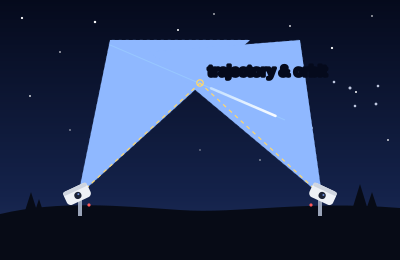
I am an Adjunct Research Professor and Research Scientist in the Department of Physics and Astronomy at Western University in London, Ontario. I build and lead research programs that turn low-cost sensors, large data sets and machine learning into answers for science, industry and government. My work spans three areas: meteor physics and planetary defence, space situational awareness and climate change mitigation. I study everything natural that enters Earth's atmosphere, from micrometre dust to potentially hazardous asteroids, and use the same cameras and software to track satellites and space debris and to measure contrails, one of the largest and most uncertain parts of aviation's climate footprint. The GMN also records satellites and rocket bodies as they re-enter the atmosphere, and we are using it to build the first systematic catalogue of optically observed re-entries.
As the GMN's founder (how it started), I direct its research, strategy and technology: the hardware, the open-source software stack, the central data infrastructure, and the international volunteer community that keeps it running.
Selected work
A few results from each of the three areas. The full list is on the Publications page.
Meteor physics and planetary defence
- Rocky material from the Oort cloud. We recorded a 2 kg meteoroid on a long-period comet orbit that broke apart and ablated like an asteroid. It is direct evidence that rocky bodies were placed in the Oort cloud while the Solar System formed. Vida et al. 2023, Nature Astronomy (cover article)
- How a small asteroid breaks up. Asteroid 2023 CX1 was discovered in space a few hours before it hit northern France. It released 98% of its energy in a single burst about 28 km above the ground, a type of break-up that raises the risk at ground level and should be part of planetary defence planning. Egal et al. 2025, Nature Astronomy
- Measuring what meteoroids are made of. Our erosion model reproduces the brightness, deceleration and wake of each meteor at once, which gives the strength and grain sizes of meteoroids from comet 1P/Halley (the Orionids). Vida et al. 2024, Icarus
Space situational awareness
- Tracking satellites without knowing where to look. Project Luciole turns GMN cameras and software into fly's-eye arrays that image the whole sky 25 times a second and track objects in low Earth orbit down to decimetre sizes. Vida et al. 2024, AMOS Conference
- Satellite and debris re-entries. We are using the GMN to build the first systematic catalogue of optically observed re-entries of satellites and rocket bodies. Do et al. 2026, AMOS Conference (paper forthcoming)
- Megaconstellations and astronomy. A large optical survey of how bright megaconstellation satellites appear and how that affects astronomical observations. Johnson et al., in review
Climate change mitigation
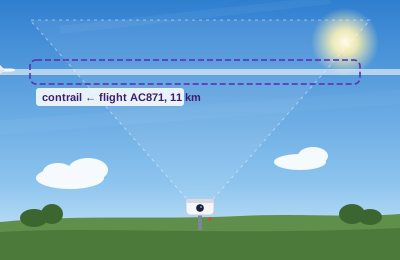
- A contrail observatory. Our cameras detect contrails day and night (over 90% accuracy) and match each one to the flight that produced it (over 95%, checked on more than 1,350 flights). The pipeline produces tens of thousands of contrail observations a month, and the first papers are in preparation. Western Contrail Research Project
- Climate change and meteorite falls. We simulated the entry of the Winchcombe meteorite through the atmosphere projected for 2100. The contracting upper atmosphere changes bright fireballs only slightly and has almost no effect on how much meteorite survives. Peña-Asensio et al. 2025, Meteoritics & Planetary Science
Where we are going
- Satellites. A nationwide optical network that observes every active satellite in low Earth orbit and provides accurate positions and brightness at high cadence, for satellite operators, astronomers, regulators and government.
- Contrails. An operational contrail observation system that supports active contrail avoidance, built with airlines, aerospace companies, regulators and government agencies.
We are well on our way. Luciole runs at four sites across Canada, the contrail pipeline produces tens of thousands of observations a month, and our data already feed work at Google Research and in the European E-CONTRAIL 2 consortium. Keeping this momentum depends on long-term support; see supporting this work.
Leading the program
Today my role is as much leadership as research. I founded the GMN, I am co-PI and technical lead of Project Luciole, and I lead the Western Contrail Research Project, where I coordinate the work, raise the funding and work with external partners. I manage a team of about ten people, including staff, research programmers, and graduate and undergraduate students. As principal investigator (PI) or co-PI I have secured over $1.7 million from industry, government and philanthropy. I scope and negotiate contracts, set deliverables and timelines, report to external stakeholders, and translate research into results partners can act on.
My training in computer engineering underpins all of it. I build production Python and C++ data pipelines, apply machine learning to detection and inference at scale, administer Linux systems, and take prototypes all the way to operational systems running worldwide.
I am always glad to connect with people working on aviation and space sustainability, Earth observation and applied AI: dvida@uwo.ca.
At a glance
- Global Meteor Network1,600+ cameras in 45 countries on all seven continents, operated by volunteers; about a petabyte of video processed every day; more than 2.8 million meteor orbits computed between 2018 and the end of 2025, about 966,000 of them in 2025 alone.
- Publications60+ peer-reviewed papers, including papers in Nature Astronomy (a 2023 cover article) and Science Advances; h-index 21 on Google Scholar.
- FundingOver $1.7 million in external funding as PI or co-PI since 2023, from industry, government and philanthropy.
- Open sourceLead developer of RMS, the GMN camera software, and the Western Meteor PyLib, used by the GMN, the Western Meteor Physics Group and NASA's Meteoroid Environment Office.
- RecognitionAsteroid (30304) Denisvida, named after me; London Inc. Top 20 Under 40 (2026); named in the Royal Astronomical Society’s 2022 Group Achievement Award in Geophysics to the UK Fireball Alliance.
- Invited talksPlenary talk at the Asteroids, Comets, Meteors conference (2026); invited talks at the American Geophysical Union (2022), Royal Astronomical Society (2022), Meteoroids 2022, Europlanet Science Congress (2024), SNOLAB (2025), the Canadian Astronomical Society (2026) and the DIRAC Institute, University of Washington (2021); full list.
- ServiceMember of the IAU Commission F1 Working Group on Meteor Shower Nomenclature; editorial board of WGN, Journal of the International Meteor Organization; member of a NASA science panel (2023); referee for Nature Astronomy, ApJ, MNRAS, Icarus, A&A and others.
- EducationPhD in Geophysics (planetary science), Western University, 2020; MEng and BEng in Computer Engineering (summa cum laude), University of Osijek, Croatia.